







Roll Up for Glass Wool: Machine and Packaging Guide


Roll up for glass wool is the process of compressing and winding suitable insulation blankets into rolls for handling and shipment. A roll-up machine controls material feeding and roll formation. Wrapping and end closure retain the roll and provide the specified package coverage, while recovery checks verify the product after unpacking.
For a production project, define the finished roll before comparing machines. Blanket dimensions, density, facing and recovery requirements determine what the equipment must handle. A smaller packed diameter is useful only when the unpacked product still meets its specification.
Where roll-up fits in the glass wool line
Roll-up belongs to the finishing end of a glass wool production line. For bonded blankets, it follows curing, cooling and sizing. The roll then moves to the agreed wrapping and downstream handling arrangement.

The glass wool cutting system establishes the dimensions received by the winder. Width, cut length, edge condition and transfer alignment all belong in the interface specification. The equipment must also accommodate the material's condition after cooling.
The curing oven is farther upstream, but its output still matters to packing. The bonded structure must suit the intended compression and recovery. A winding adjustment should not be used to hide a product-quality issue that begins earlier in the line.
How pre-compression and winding work together
Pre-compression reduces the mat thickness before winding. The winding mechanism then forms the blanket into a roll while controlling how the material is held as the roll grows. Machine designs differ, so the operating sequence and drive arrangement need to be identified in the proposal.
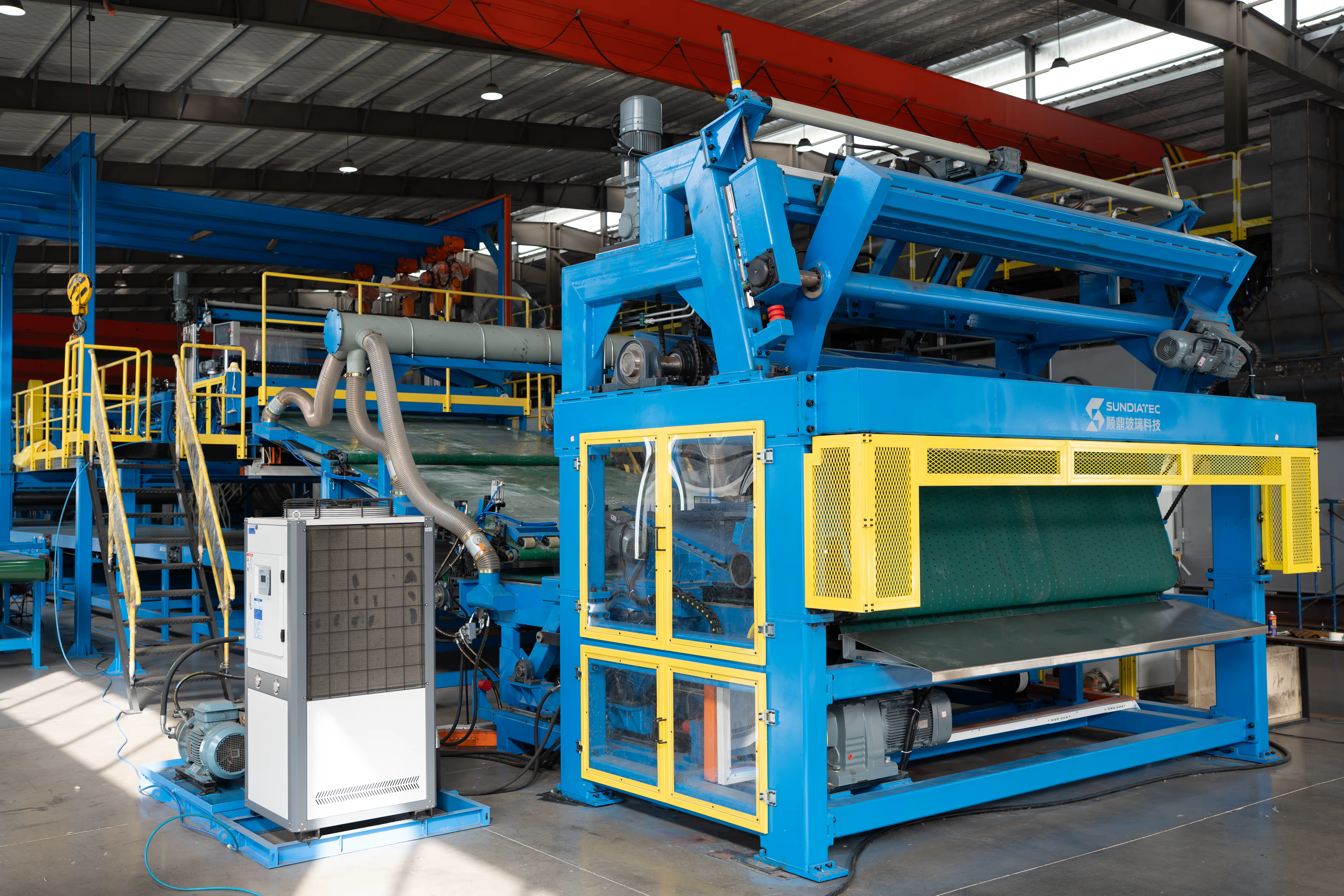
Sundiatec's roll-up glass wool machinery includes a servo-controlled pre-press arrangement. Its published description also lists simultaneous winding of multiple products. The number of lanes, product range and sustained output should be confirmed for the proposed configuration.
Pre-compression, winding pressure and the final packed diameter describe related but different conditions. Ask how the selected machine controls the roll across its length, including the start and end of the blanket. A consistent outer shape alone does not prove that compression is uniform throughout the roll.
Start with a product and roll specification
The machine needs to accommodate a defined product range. Plain blankets and faced blankets can behave differently during feeding and winding, even when their nominal dimensions match.
Do not assume every glass wool board is suitable for winding. Use representative samples of the actual flexible product, including the facing where applicable. A product catalogue's range of densities or thicknesses is not automatically the operating range of a particular roll-up machine.
Validate compression through recovery tests
The acceptable compression level must be established for the product. Test both the package and the unpacked blanket under agreed conditions before accepting a proposed setting.

Record the original dimensions, packed geometry, storage duration and conditions, then measure the product after the specified recovery interval. Inspect the blanket along its length rather than checking only the outermost part. Include facing appearance, edge damage and the relevant product performance requirements.
Define what a quoted compression ratio means. A ratio based on mat thickness differs from one based on package volume. Neither should be inferred from the roll diameter alone. Ask for the calculation basis and the product used in the trial.
A supplier demonstration on one easy-to-wind blanket does not cover the whole production mix. Include the products most likely to challenge feeding, compression or recovery, as well as the formats that account for most sales. Acceptance should state the tolerances and measurement method rather than simply require a “good roll.”
Define wrapping and end closure separately
Winding forms the roll. A retaining wrap keeps it from unwinding, while end closure determines coverage of the circular faces. These functions may be integrated or supplied as separate modules.

Specify film or paper compatibility, how the package is retained and whether the ends remain open. Where shrinking is proposed, check the film and the product construction together. A wrapping machine, end-shrinking unit and pallet-handling system should not be assumed included in the winder price.
Ask to inspect the finished package from all sides and through the intended handling route. Packaging must suit the specified storage and transport conditions. A closed-looking package does not establish weather resistance without the appropriate material, sealing and validation.
Convert line speed into finished-roll output
Compare output in accepted rolls per minute for a named product. Conveyor speed in metres per minute does not by itself show the rate at which complete rolls leave the packaging section.
For a single lane, dividing continuous incoming length per minute by blanket length per roll gives the incoming roll-equivalent rate. As an illustration, 30 metres per minute divided by 15 metres per roll equals 2 roll-equivalents per minute. These figures are a planning example, not a Sundiatec machine rating.
The equipment must also complete roll initiation, winding, discharge and any wrapping cycle. Film replenishment, rejected products and downstream delays affect sustained output. For multiple lanes, establish how each lane is fed and whether discharge or packing resources are shared.
Agree the trial duration and how stoppages are counted. The proposed line should handle the planned product mix, including routine changeovers. Peak performance during an uninterrupted short run can overstate the useful rate over a production shift.
Plan changeovers and control interfaces
Product recipes should connect the material settings with the required roll format. Review which settings change automatically and which need mechanical adjustment or operator checks.
When selecting glass wool production equipment, coordinate the cutter, conveyors, winder and packaging modules. Define the handover signals and the response when one section cannot receive more material. Buffer space only helps if its usable capacity and restart sequence match the process.
For an upgrade, provide existing conveyor elevations, product-transfer drawings and control information. Leave access for film replacement, cleaning and maintenance. Confirm how a product change is verified before normal output resumes, especially when the facing or blanket thickness changes.
Use trial observations to investigate roll defects
Several conditions can produce a similar visible defect. Record when the problem occurs and check the product entering the machine before changing the winding settings.
These are investigation paths, not a diagnosis from appearance alone. The equipment and product teams should agree the corrective action and repeat the relevant checks after changes.
Frequently asked questions
Is a roll-up machine the same as a wrapping machine?
No. The roll-up machine forms the blanket into a roll. Wrapping retains that roll, and end closure provides the specified coverage. A supplier can integrate these functions, but the quotation should identify the included modules and the condition of the package at discharge.
What compression ratio should glass wool use?
There is no single ratio for every product. Density, structure, facing and the required recovery all affect the acceptable setting. Define how the ratio is calculated, then verify it with the actual blanket after the proposed storage period and recovery interval.
Can foil-faced glass wool be rolled?
Faced glass wool blankets are available in roll form, but compatibility depends on the particular construction and equipment. Include the actual facing in machine trials. Inspect adhesion, creasing and damage after winding and unpacking instead of assuming a plain-blanket trial covers faced products.
Can the machine also wind rock wool?
Some equipment suppliers offer winding systems for both materials. That does not establish compatibility for every configuration. The rock wool product needs a separate assessment of flexibility, dimensions, compression and recovery. Confirm the proposed range with trials and the supplier's technical offer.
Does a smaller roll always reduce shipping cost?
Reducing volume can help when a shipment is volume-limited. Actual freight cost also depends on mass, loading geometry, handling units and transport conditions. Compare the complete shipping unit and include damage or recovery losses before treating a smaller roll diameter as a saving.
What should be supplied for a roll-up machine quotation?
Provide a product list with density, thickness, width, roll length and facing. Add target output, package dimensions, recovery criteria and the required wrapping scope. For an existing line, include the available layout, conveyor interfaces and the current capacity or quality issue.
Discuss the roll-up section with Sundiatec
Share your glass wool product range and desired packed-roll format with Sundiatec. Ask for a configuration that connects the pre-press and winding section to cutting, wrapping and discharge. Agree the representative trial products and acceptance criteria before finalising the equipment scope.